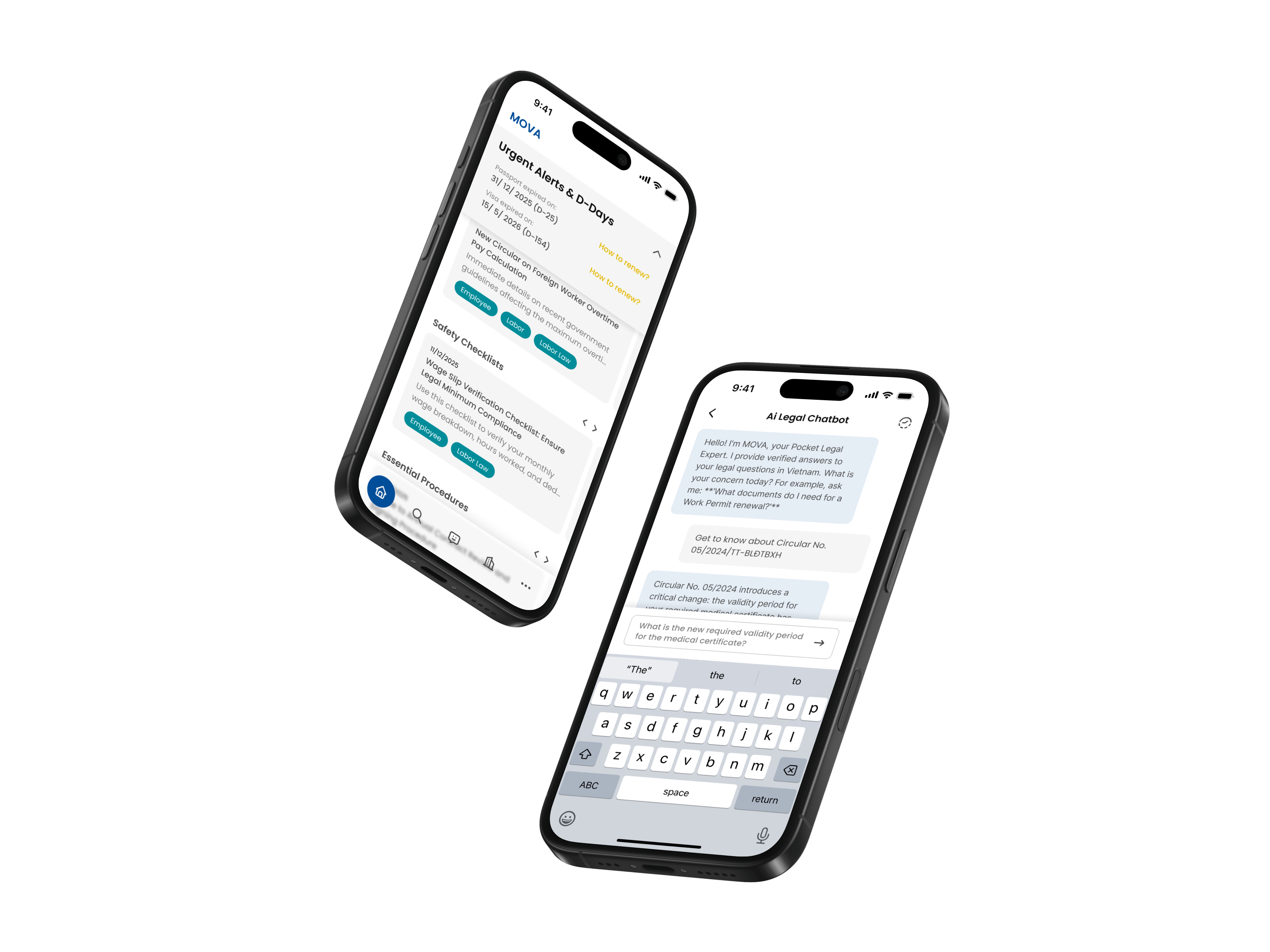
MOVA
Legal clarity in your pocket. Anytime, anywhere.
Period
Nov ~ Dec, 2025
Role
Product Designer
Tool
Figma
Industry
Legal
PROJECT OVERVIEW
MOVA is a legal assistance service designed for Korean tourists and residents who face challenges navigating the complexity and language barriers of local Vietnamese law.
The goal of this project is to create a "Pocket Legal Expert" that replaces user anxiety with confidence. I served as the sole designer, managing the entire process from user research and strategy definition to final UI conceptualization, ensuring the solution was built entirely around the user's voice.
BACKGROUND
“The Knowledge Gap”
Over my 8 years living in Ho Chi Minh City, I have witnessed the rapid surge in Korean visitors and investment. However, I also realized that many foreigners struggle to keep up with the frequently changing local laws, often lacking even basic legal awareness.
This 'Knowledge Gap' leaves residents and travelers vulnerable in urgent situations. Driven by this insight, I designed MOVA to bridge that gap—providing accessible, customized guidance to ensure users are equipped with the minimum legal knowledge necessary for their safety.
EMPATHY
To understand the real-world challenges faced by Koreans regarding local laws in Vietnam, I conducted in-depth interviews.
Participants
3 Koreans in their 20s and 30s currently residing in Vietnam
Objective
To listen to their firsthand experiences with legal issues they have encountered
Key Question
"Could you share a personal story about a legal problem you've faced in Vietnam?"

Interviewee A
36 years Korean, currently working in a Korean company in Ho Chi Minh
“I visited a Korean company in Vietnam for employment purposes, but I was unable to meet the required documents for a work visa, and as a result, had to return to Korea and re-enter Vietnam.”
Key Insight
Difficulty obtaining pre-emptive, personalized procedure and documentation knowledge.

Interviewee B
33 years Korean, currently working in a Japanese company in Ho Chi Minh
“I’m working at a Japanese company in Vietnam,
and I had been unaware of Vietnamese labor laws and worked for 5 years without any objection to the company policy of not paying severance pay when I joined.”
Key Insight
Foreign workers in Vietnam often lack basic knowledge of local labor laws, leading them to unknowingly accept company policies that infringe on their legal rights, such as severance pay.

Interviewee C
28 years Korean, currently working in a Korean company in Ho Chi Minh
“I have been assaulted at a club by a male and experienced delays in resolving the issue due to the confusing situation and I limited proficiency in Vietnamese.”
Key Insight
Difficulty resolving urgent, on-site issues due to language and procedural confusion.
DEFINE
Problem Statement
Koreans residing in Vietnam face legal issues unique to their residency status and purpose of activity. Despite this, they struggle to filter and understand the vast body of Vietnamese law to find relevant, customized information.
This leads to a lack of 'Personalization' and a 'High Barrier to Understanding', causing a failure to recognize legal risks in advance and respond effectively in emergencies.
H.M.W...? (How Might We...?)
How might we utilize AI-driven personalized legal content curation to filter core legal information based on user profiles (residency type/activity purpose) and enable proactive response to legal risks through clear explanations in Korean?
IDEATE
AI Personalization Strategy
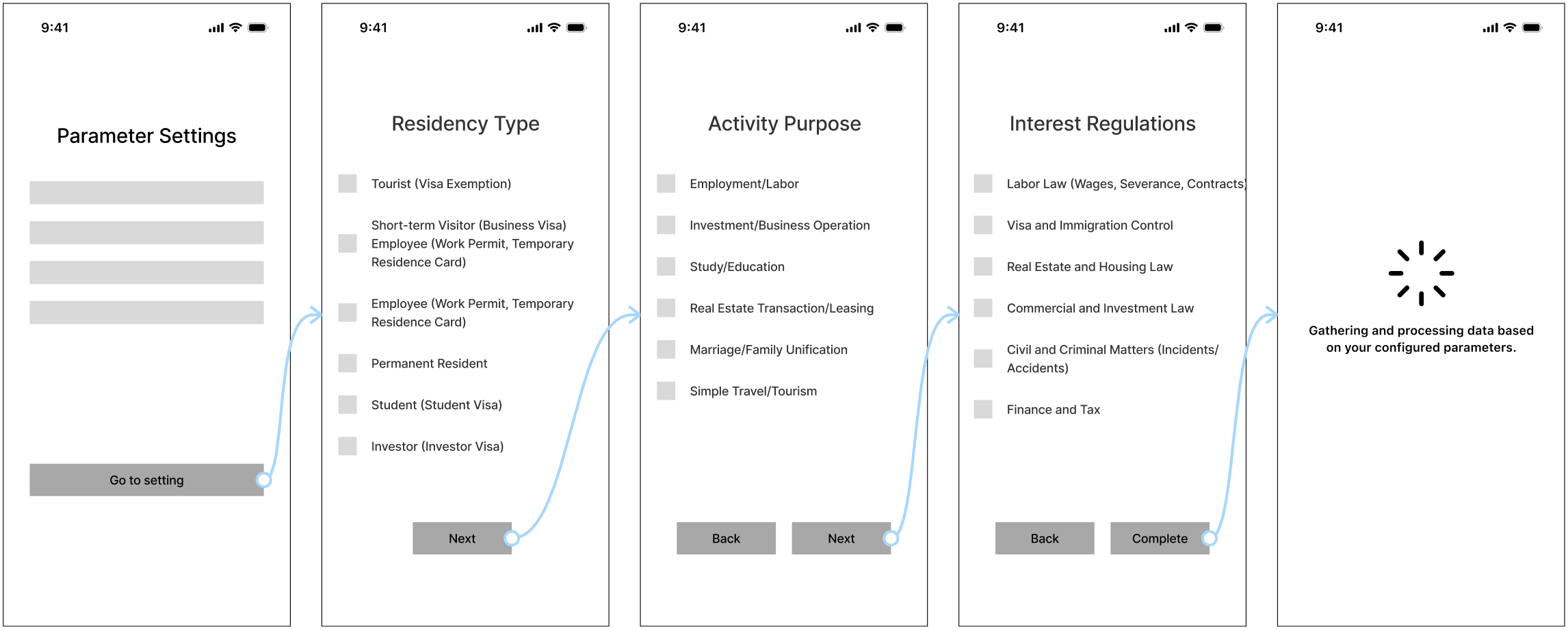
Everyone who lives in or visits Vietnam has different goals. Because of this, the legal information they need is also different. MOVA solves this problem by letting users choose their personal settings (like visa type, purpose, and law interests) when they sign up. This system removes things you don't need, so you only see the important information that matches your situation.
Core Features Defined by Value
Custom Legal News Curator
Provides summaries of the most urgent and important laws based on settings (e.g., job seeker: summary of essential visa procedures for labor).

Legal Search Function
If users have questions beyond the curated information, they can obtain the necessary details through keyword search in the search bar. The search results will prioritize information related to the parameters that the user has set in advance.

AI Q&A Chatbot
An AI Chatbot floating button is accessible across the entire service, allowing users to instantly inquire about any legal information they are curious about. Furthermore, if a user taps the Chatbot button while reading a specific curated news article, they can utilize recommended questions directly related to that content.
Local Expert Connection
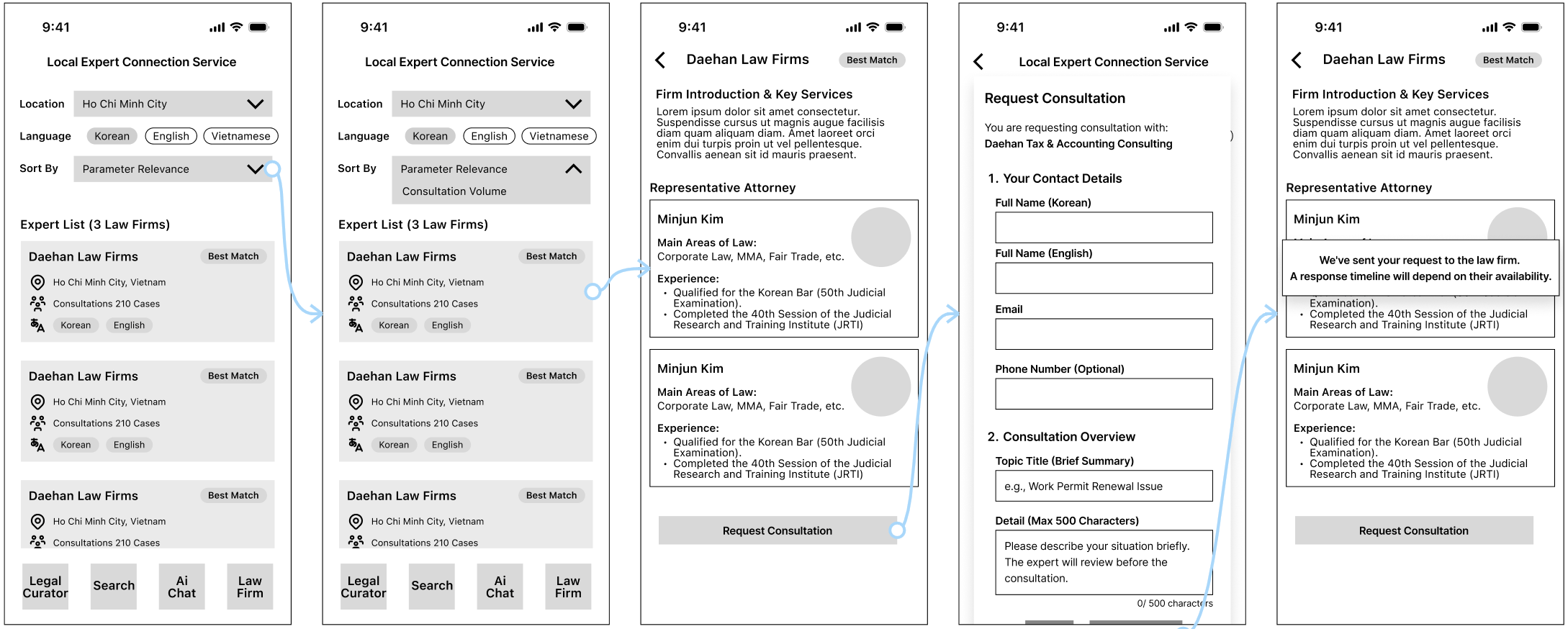
If a user faces an urgent legal dispute, they can easily search for law firms that support their preferred language in their current location using the Location and Language Settings. Furthermore, they can immediately submit a legal consultation request to the selected firm.

LOW FIDELITY
WIREFRAME
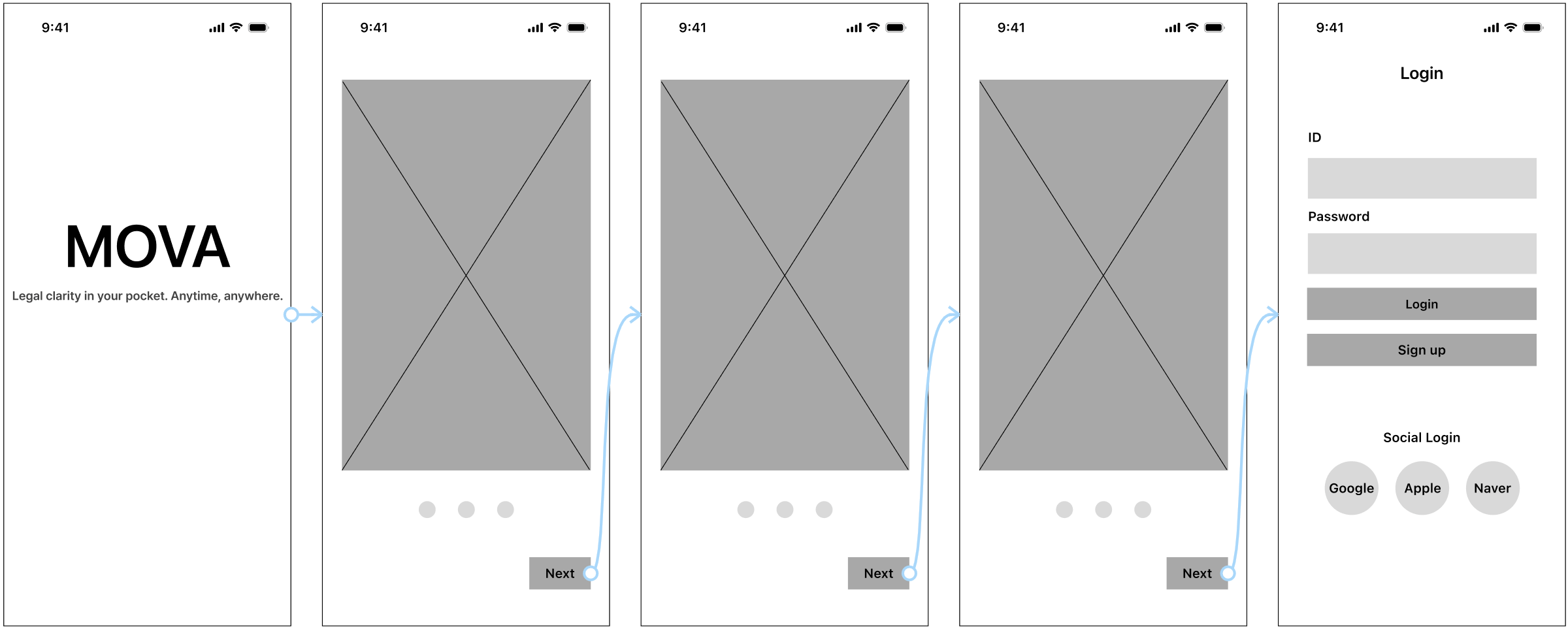
1. Onboarding
2. Parameter Settings
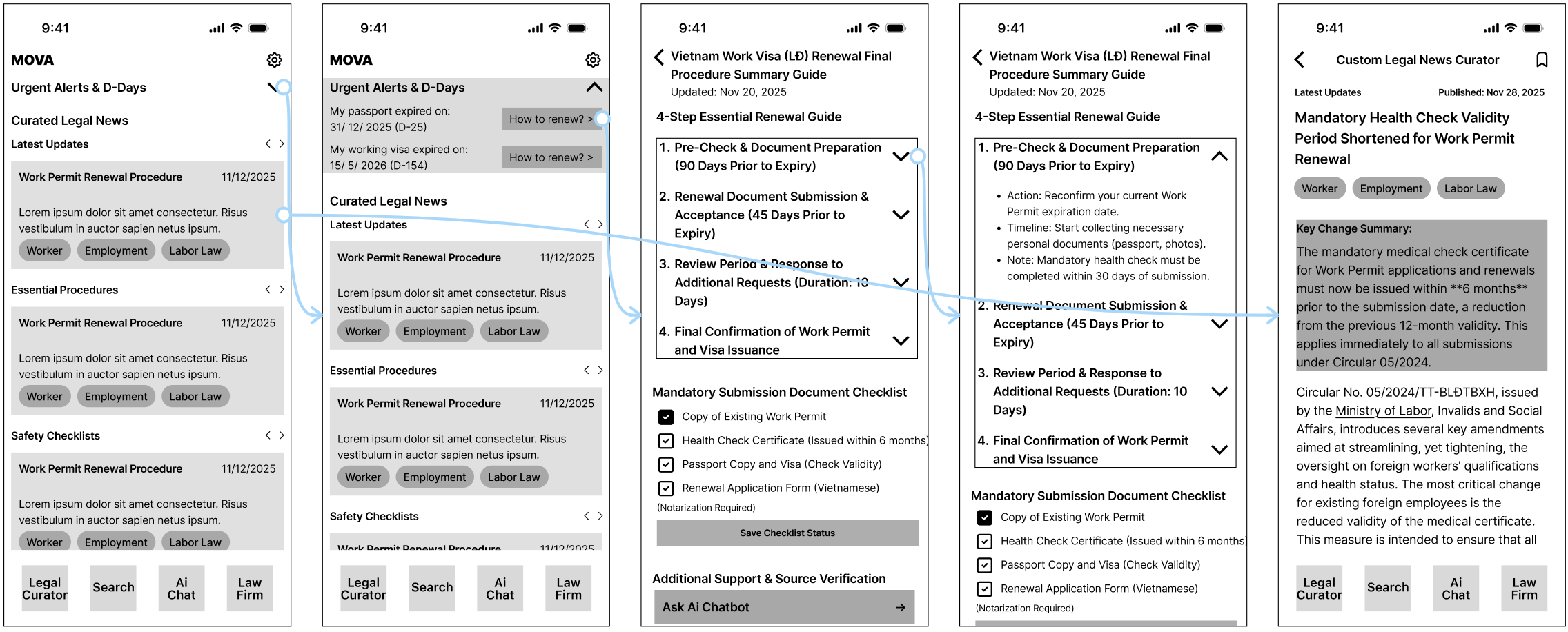
3. Curated Legal Information
4. Search Page
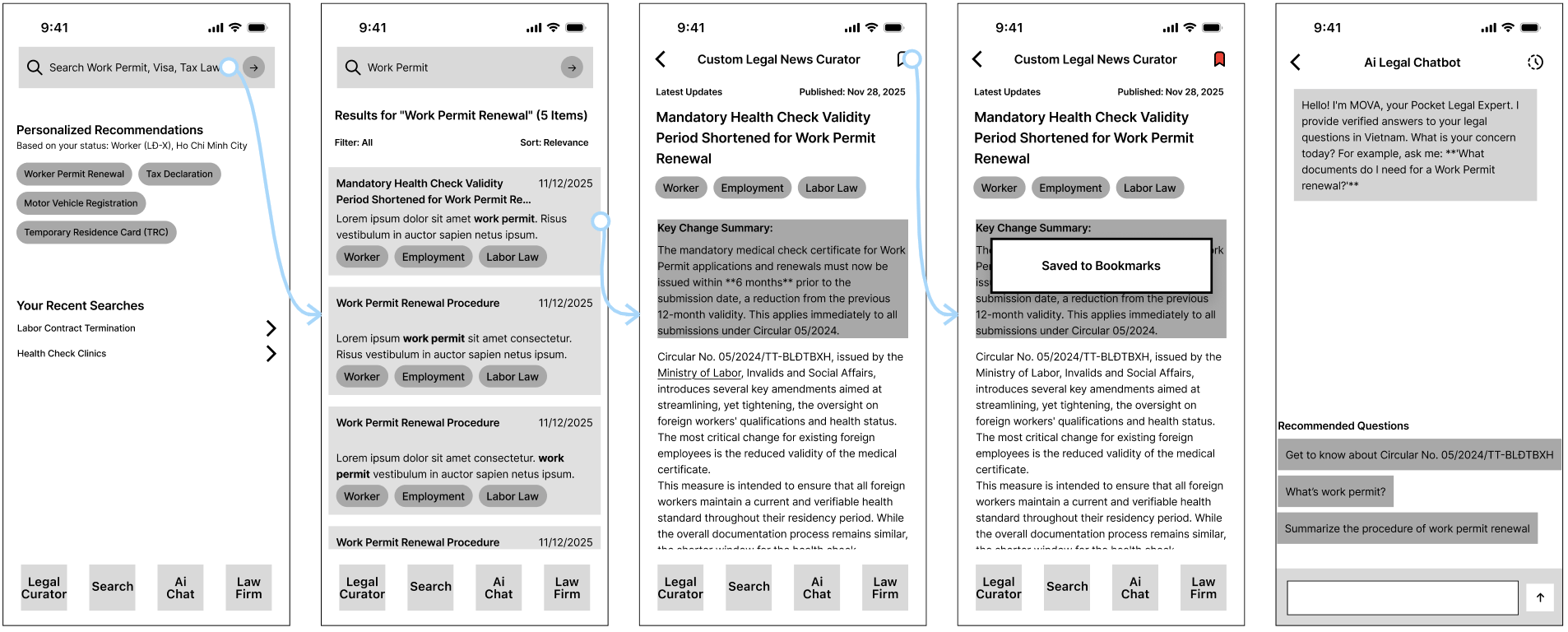
5. Search Page
6. Local Expert Service
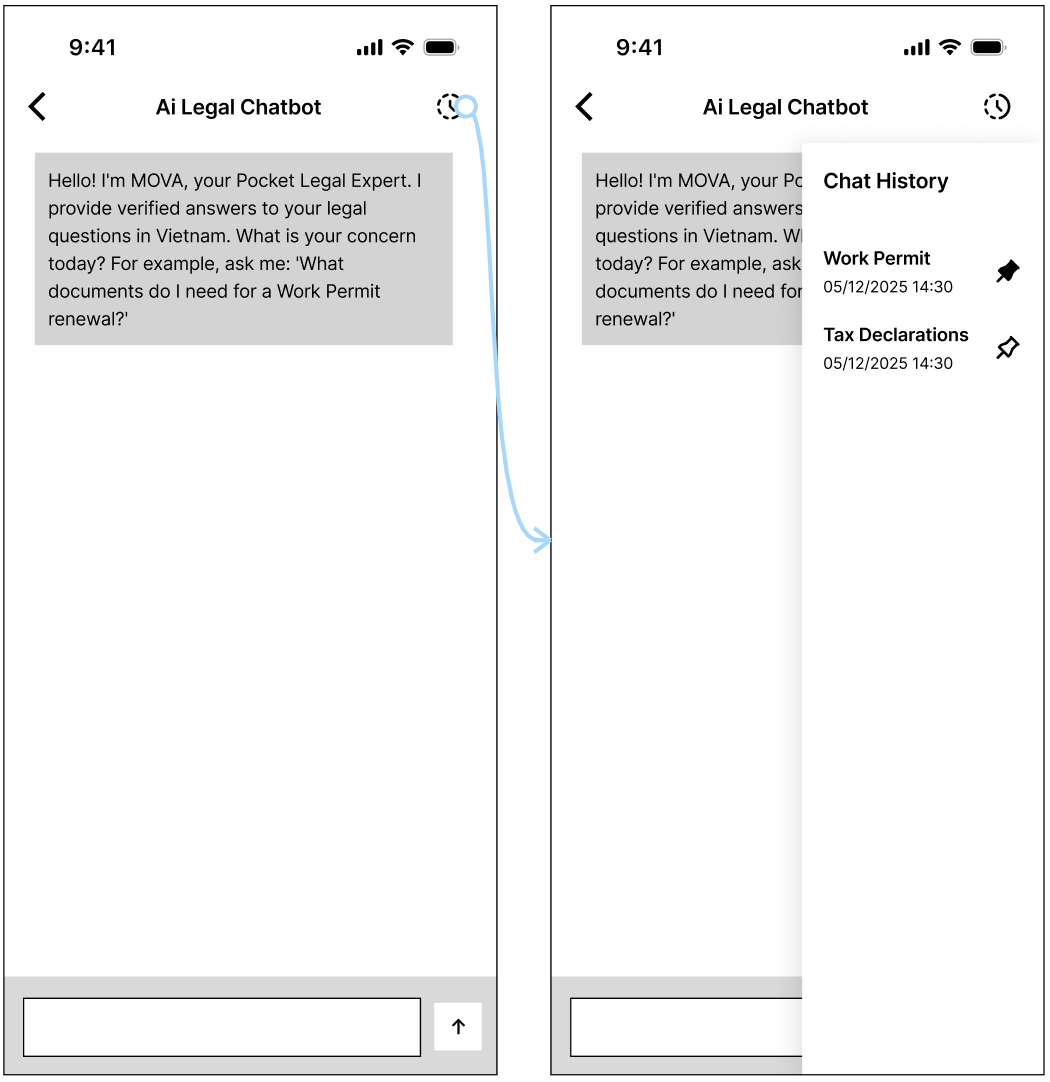
7. Ai Chatbot
USER TEST
After completing the High Fidelity Wireframes, I conducted user testing with five participants. All were Korean professionals in their 30s working in Ho Chi Minh City, perfectly matching the service's target persona.
Participants were asked to navigate through MOVA’s key features in detail, and I collected qualitative feedback on their overall experience.
✅ Key Strengths
Hyper-Personalization
"Users appreciated accessing the latest legal trends and information specifically tailored to their residency status in Vietnam."
Professionalism & Efficiency
"Compared to generic AI like ChatGPT, MOVA feels more professional. Users especially liked that they didn't have to manually search for and organize information themselves."
Seamless Expert Connection
"Users found it very convenient to seamlessly connect with real-world experts when facing actual legal issues."
In-depth Information Access
"It was easy to obtain in-depth information on their specific interests using just a few keywords."
❗️ Areas for Improvement
Proactive AI Suggestions
"It would be more convenient if the AI Chatbot proactively suggested applying for a law firm consultation based on the conversation context."
Bookmarking System
"Users requested a dedicated page to view and manage their saved legal news and articles."
Social Proof & Reviews
"Users wanted to check reviews and ratings on the search page. This social proof is essential to reduce anxiety when choosing an unverified law firm in a foreign environment."
HIGH FIDELITY
WIREFRAME
1. Onboarding
For first-time users, the onboarding flow introduces MOVA’s three core features before the sign-up process.
It highlights 'Personalized Information Curation', the 'AI Chatbot', and 'Expert Connection' to clearly communicate the service's value from the start.
2. Urgent Alerts & D-Days
Managing visas and passports is crucial but often overlooked by foreigners. Since relying solely on agents can be risky with frequently changing laws, I placed the expiration dates and renewal guides at the very top of the main page.
3. Curated Legal News
On the main page, legal information is organized into categories like 'Latest Updates', 'Essential Procedures', and 'Safety Checklists'.
This content is curated by AI based on the user's pre-set parameters. Also, I placed 'View Full Original Text' and 'Ask AI' buttons at the bottom of each article. This allows users to easily check the original source or ask more questions if needed.
4. Search Page
The Search Page is designed for users who want to actively find specific information. Users can type keywords into the search bar or simply click on questions recommended by AI based on their parameters.
5. Local Expert Service
With the Expert Service, users can schedule consultations with professional lawyers for urgent or complex legal matters. Users can filter law firms based on their preferred location and language. I designed the entire process to be seamless, allowing users to submit consultation requests directly within the app.
6. Ai Chatbot
There are two ways to access the AI Chatbot. First, users can tap the 'AI Chatbot' button on the bottom navigation bar. This allows them to chat freely, just like standard AI services.
Second, they can use the 'Ask AI' button inside a news detail page. In this mode, users receive recommended questions specifically related to that article.
7. My Page
Based on insights from user testing, I designed 'My Page' to allow users to access their archived legal information at any time. This ensures that important saved content is always within easy reach.
PROTOTYPE
KEY TAKEAWAYS
1. The Power of Dual Perspective
As a foreign resident in Vietnam, this project was deeply personal. Being both the designer and a potential user allowed me to fully immerse myself in the problem. This dual perspective helped me design solutions that are not just functional, but truly authentic to the user's needs.
2. Translating Empathy into Design
Through user interviews, I learned that empathy is more than just listening. The real challenge—and value—was translating those user frustrations into tangible UI features. This process taught me how to turn emotional insights into practical solutions.
3. Overcoming Bias through Validation
Since I was also a target user, the biggest risk was designing only for myself. User testing was crucial in breaking my subjective bias. It helped me pivot from what I thought was best to what the users actually needed, proving the importance of objective validation.
MOVA
Legal clarity in your pocket. Anytime, anywhere.
Period
Nov ~ Dec, 2025
Role
Product Designer
Tool
Figma
Industry
Legal
PROJECT OVERVIEW
MOVA is a legal assistance service designed for Korean tourists and residents who face challenges navigating the complexity and language barriers of local Vietnamese law.
The goal of this project is to create a "Pocket Legal Expert" that replaces user anxiety with confidence. I served as the sole designer, managing the entire process from user research and strategy definition to final UI conceptualization, ensuring the solution was built entirely around the user's voice.
BACKGROUND
“The Knowledge Gap”
Over my 8 years living in Ho Chi Minh City, I have witnessed the rapid surge in Korean visitors and investment. However, I also realized that many foreigners struggle to keep up with the frequently changing local laws, often lacking even basic legal awareness.
This 'Knowledge Gap' leaves residents and travelers vulnerable in urgent situations. Driven by this insight, I designed MOVA to bridge that gap—providing accessible, customized guidance to ensure users are equipped with the minimum legal knowledge necessary for their safety.
EMPATHY
To understand the real-world challenges faced by Koreans regarding local laws in Vietnam, I conducted in-depth interviews.
Participants
3 Koreans in their 20s and 30s currently residing in Vietnam
Objective
To listen to their firsthand experiences with legal issues they have encountered
Key Question
"Could you share a personal story about a legal problem you've faced in Vietnam?"

Interviewee A
36 years Korean, currently working in a Korean company in Ho Chi Minh
“I visited a Korean company in Vietnam for employment purposes, but I was unable to meet the required documents for a work visa, and as a result, had to return to Korea and re-enter Vietnam.”
Key Insight
Difficulty obtaining pre-emptive, personalized procedure and documentation knowledge.
Interviewee B
33 years Korean, currently working in a Japanese company in Ho Chi Minh
“I’m working at a Japanese company in Vietnam,
and I had been unaware of Vietnamese labor laws and worked for 5 years without any objection to the company policy of not paying severance pay when I joined.”
Key Insight
Foreign workers in Vietnam often lack basic knowledge of local labor laws, leading them to unknowingly accept company policies that infringe on their legal rights, such as severance pay.


Interviewee C
28 years Korean, currently working in a Korean company in Ho Chi Minh
“I have been assaulted at a club by a male and experienced delays in resolving the issue due to the confusing situation and I limited proficiency in Vietnamese.”
Key Insight
Difficulty resolving urgent, on-site issues due to language and procedural confusion.
DEFINE
Problem Statement
Koreans residing in Vietnam face legal issues unique to their residency status and purpose of activity. Despite this, they struggle to filter and understand the vast body of Vietnamese law to find relevant, customized information.
This leads to a lack of 'Personalization' and a 'High Barrier to Understanding', causing a failure to recognize legal risks in advance and respond effectively in emergencies.
H.M.W...?
(How Might We...?)
How might we utilize AI-driven personalized legal content curation to filter core legal information based on user profiles (residency type/activity purpose) and enable proactive response to legal risks through clear explanations in Korean?
IDEATE
AI Personalization Strategy
Everyone who lives in or visits Vietnam has different goals. Because of this, the legal information they need is also different. MOVA solves this problem by letting users choose their personal settings (like visa type, purpose, and law interests) when they sign up. This system removes things you don't need, so you only see the important information that matches your situation.
Core Features Defined by Value
Custom Legal News Curator
Provides summaries of the most urgent and important laws based on settings (e.g., job seeker: summary of essential visa procedures for labor).
Legal Search Function
If users have questions beyond the curated information, they can obtain the necessary details through keyword search in the search bar. The search results will prioritize information related to the parameters that the user has set in advance.
AI Q&A Chatbot
An AI Chatbot floating button is accessible across the entire service, allowing users to instantly inquire about any legal information they are curious about. Furthermore, if a user taps the Chatbot button while reading a specific curated news article, they can utilize recommended questions directly related to that content.
Local Expert Connection
If a user faces an urgent legal dispute, they can easily search for law firms that support their preferred language in their current location using the Location and Language Settings. Furthermore, they can immediately submit a legal consultation request to the selected firm.
LOW FIDELITY WIREFRAME
1. Onboarding
2. Parameter Settings
3. Curated Legal Information
4. Search Page
5. Search Page
6. Local Expert Service
7. Ai Chatbot
USER TEST
After completing the High Fidelity Wireframes, I conducted user testing with five participants. All were Korean professionals in their 30s working in Ho Chi Minh City, perfectly matching the service's target persona.
Participants were asked to navigate through MOVA’s key features in detail, and I collected qualitative feedback on their overall experience.
✅ Key Strengths
Hyper-Personalization
"Users appreciated accessing the latest legal trends and information specifically tailored to their residency status in Vietnam."
Professionalism & Efficiency
"Compared to generic AI like ChatGPT, MOVA feels more professional. Users especially liked that they didn't have to manually search for and organize information themselves."
Seamless Expert Connection
"Users found it very convenient to seamlessly connect with real-world experts when facing actual legal issues."
In-depth Information Access
"It was easy to obtain in-depth information on their specific interests using just a few keywords."
❗️ Areas for Improvement
Proactive AI Suggestions
"It would be more convenient if the AI Chatbot proactively suggested applying for a law firm consultation based on the conversation context."
Bookmarking System
"Users requested a dedicated page to view and manage their saved legal news and articles."
Social Proof & Reviews
"Users wanted to check reviews and ratings on the search page. This social proof is essential to reduce anxiety when choosing an unverified law firm in a foreign environment."
HIGH FIDELITY WIREFRAME
1. Onboarding
For first-time users, the onboarding flow introduces MOVA’s three core features before the sign-up process.
It highlights 'Personalized Information Curation', the 'AI Chatbot', and 'Expert Connection' to clearly communicate the service's value from the start.
2. Urgent Alerts & D-Days
Managing visas and passports is crucial but often overlooked by foreigners. Since relying solely on agents can be risky with frequently changing laws, I placed the expiration dates and renewal guides at the very top of the main page.
3. Curated Legal News
On the main page, legal information is organized into categories like 'Latest Updates', 'Essential Procedures', and 'Safety Checklists'.
This content is curated by AI based on the user's pre-set parameters. Also, I placed 'View Full Original Text' and 'Ask AI' buttons at the bottom of each article. This allows users to easily check the original source or ask more questions if needed.
4. Search Page
The Search Page is designed for users who want to actively find specific information. Users can type keywords into the search bar or simply click on questions recommended by AI based on their parameters.
5. Local Expert Service
With the Expert Service, users can schedule consultations with professional lawyers for urgent or complex legal matters. Users can filter law firms based on their preferred location and language. I designed the entire process to be seamless, allowing users to submit consultation requests directly within the app.
6. Ai Chatbot
There are two ways to access the AI Chatbot. First, users can tap the 'AI Chatbot' button on the bottom navigation bar. This allows them to chat freely, just like standard AI services.
Second, they can use the 'Ask AI' button inside a news detail page. In this mode, users receive recommended questions specifically related to that article.
7. My Page
Based on insights from user testing, I designed 'My Page' to allow users to access their archived legal information at any time. This ensures that important saved content is always within easy reach.
PROTOTYPE
KEY TAKEAWAYS
1. The Power of Dual Perspective
As a foreign resident in Vietnam, this project was deeply personal. Being both the designer and a potential user allowed me to fully immerse myself in the problem. This dual perspective helped me design solutions that are not just functional, but truly authentic to the user's needs.
2. Translating Empathy into Design
Through user interviews, I learned that empathy is more than just listening. The real challenge—and value—was translating those user frustrations into tangible UI features. This process taught me how to turn emotional insights into practical solutions.
3. Overcoming Bias through Validation
Since I was also a target user, the biggest risk was designing only for myself. User testing was crucial in breaking my subjective bias. It helped me pivot from what I thought was best to what the users actually needed, proving the importance of objective validation.
MOVA
Legal clarity in your pocket. Anytime, anywhere.
Period
Nov ~ Dec, 2025
Role
Product Designer
Tool
Figma
Industry
Legal
PROJECT OVERVIEW
MOVA is a legal assistance service designed for Korean tourists and residents who face challenges navigating the complexity and language barriers of local Vietnamese law.
The goal of this project is to create a "Pocket Legal Expert" that replaces user anxiety with confidence. I served as the sole designer, managing the entire process from user research and strategy definition to final UI conceptualization, ensuring the solution was built entirely around the user's voice.
BACKGROUND
“The Knowledge Gap”
Over my 8 years living in Ho Chi Minh City, I have witnessed the rapid surge in Korean visitors and investment. However, I also realized that many foreigners struggle to keep up with the frequently changing local laws, often lacking even basic legal awareness.
This 'Knowledge Gap' leaves residents and travelers vulnerable in urgent situations. Driven by this insight, I designed MOVA to bridge that gap—providing accessible, customized guidance to ensure users are equipped with the minimum legal knowledge necessary for their safety.
EMPATHY
To understand the real-world challenges faced by Koreans regarding local laws in Vietnam, I conducted in-depth interviews.
Participants
3 Koreans in their 20s and 30s currently residing in Vietnam
Objective
To listen to their firsthand experiences with legal issues they have encountered
Key Question
"Could you share a personal story about a legal problem you've faced in Vietnam?"

Interviewee A
36 years Korean, currently working in a Korean company in Ho Chi Minh
“I visited a Korean company in Vietnam for employment purposes, but I was unable to meet the required documents for a work visa, and as a result, had to return to Korea and re-enter Vietnam.”
Key Insight
Difficulty obtaining pre-emptive, personalized procedure and documentation knowledge.
Interviewee B
33 years Korean, currently working in a Japanese company in Ho Chi Minh
“I’m working at a Japanese company in Vietnam,
and I had been unaware of Vietnamese labor laws and worked for 5 years without any objection to the company policy of not paying severance pay when I joined.”
Key Insight
Foreign workers in Vietnam often lack basic knowledge of local labor laws, leading them to unknowingly accept company policies that infringe on their legal rights, such as severance pay.


Interviewee C
28 years Korean, currently working in a Korean company in Ho Chi Minh
“I have been assaulted at a club by a male and experienced delays in resolving the issue due to the confusing situation and I limited proficiency in Vietnamese.”
Key Insight
Difficulty resolving urgent, on-site issues due to language and procedural confusion.
DEFINE
Problem Statement
Koreans residing in Vietnam face legal issues unique to their residency status and purpose of activity. Despite this, they struggle to filter and understand the vast body of Vietnamese law to find relevant, customized information.
This leads to a lack of 'Personalization' and a 'High Barrier to Understanding', causing a failure to recognize legal risks in advance and respond effectively in emergencies.
H.M.W...?
(How Might We...?)
How might we utilize AI-driven personalized legal content curation to filter core legal information based on user profiles (residency type/activity purpose) and enable proactive response to legal risks through clear explanations in Korean?
IDEATE
AI Personalization Strategy
Everyone who lives in or visits Vietnam has different goals. Because of this, the legal information they need is also different. MOVA solves this problem by letting users choose their personal settings (like visa type, purpose, and law interests) when they sign up. This system removes things you don't need, so you only see the important information that matches your situation.
Core Features Defined by Value
Custom Legal News Curator
Provides summaries of the most urgent and important laws based on settings (e.g., job seeker: summary of essential visa procedures for labor).
Legal Search Function
If users have questions beyond the curated information, they can obtain the necessary details through keyword search in the search bar. The search results will prioritize information related to the parameters that the user has set in advance.
AI Q&A Chatbot
An AI Chatbot floating button is accessible across the entire service, allowing users to instantly inquire about any legal information they are curious about. Furthermore, if a user taps the Chatbot button while reading a specific curated news article, they can utilize recommended questions directly related to that content.
Local Expert Connection
If a user faces an urgent legal dispute, they can easily search for law firms that support their preferred language in their current location using the Location and Language Settings. Furthermore, they can immediately submit a legal consultation request to the selected firm.
LOW FIDELITY WIREFRAME
1. Onboarding
2. Parameter Settings
3. Curated Legal Information
4. Search Page
5. Search Page
6. Local Expert Service
7. Ai Chatbot
USER TEST
After completing the High Fidelity Wireframes, I conducted user testing with five participants. All were Korean professionals in their 30s working in Ho Chi Minh City, perfectly matching the service's target persona.
Participants were asked to navigate through MOVA’s key features in detail, and I collected qualitative feedback on their overall experience.
✅ Key Strengths
Hyper-Personalization
"Users appreciated accessing the latest legal trends and information specifically tailored to their residency status in Vietnam."
Professionalism & Efficiency
"Compared to generic AI like ChatGPT, MOVA feels more professional. Users especially liked that they didn't have to manually search for and organize information themselves."
Seamless Expert Connection
"Users found it very convenient to seamlessly connect with real-world experts when facing actual legal issues."
In-depth Information Access
"It was easy to obtain in-depth information on their specific interests using just a few keywords."
❗️ Areas for Improvement
Proactive AI Suggestions
"It would be more convenient if the AI Chatbot proactively suggested applying for a law firm consultation based on the conversation context."
Bookmarking System
"Users requested a dedicated page to view and manage their saved legal news and articles."
Social Proof & Reviews
"Users wanted to check reviews and ratings on the search page. This social proof is essential to reduce anxiety when choosing an unverified law firm in a foreign environment."
HIGH FIDELITY WIREFRAME
1. Onboarding
For first-time users, the onboarding flow introduces MOVA’s three core features before the sign-up process.
It highlights 'Personalized Information Curation', the 'AI Chatbot', and 'Expert Connection' to clearly communicate the service's value from the start.
2. Urgent Alerts & D-Days
Managing visas and passports is crucial but often overlooked by foreigners. Since relying solely on agents can be risky with frequently changing laws, I placed the expiration dates and renewal guides at the very top of the main page.
3. Curated Legal News
On the main page, legal information is organized into categories like 'Latest Updates', 'Essential Procedures', and 'Safety Checklists'.
This content is curated by AI based on the user's pre-set parameters. Also, I placed 'View Full Original Text' and 'Ask AI' buttons at the bottom of each article. This allows users to easily check the original source or ask more questions if needed.
4. Search Page
The Search Page is designed for users who want to actively find specific information. Users can type keywords into the search bar or simply click on questions recommended by AI based on their parameters.
5. Local Expert Service
With the Expert Service, users can schedule consultations with professional lawyers for urgent or complex legal matters. Users can filter law firms based on their preferred location and language. I designed the entire process to be seamless, allowing users to submit consultation requests directly within the app.
6. Ai Chatbot
There are two ways to access the AI Chatbot. First, users can tap the 'AI Chatbot' button on the bottom navigation bar. This allows them to chat freely, just like standard AI services.
Second, they can use the 'Ask AI' button inside a news detail page. In this mode, users receive recommended questions specifically related to that article.
7. My Page
Based on insights from user testing, I designed 'My Page' to allow users to access their archived legal information at any time. This ensures that important saved content is always within easy reach.
PROTOTYPE
KEY TAKEAWAYS
1. The Power of Dual Perspective
As a foreign resident in Vietnam, this project was deeply personal. Being both the designer and a potential user allowed me to fully immerse myself in the problem. This dual perspective helped me design solutions that are not just functional, but truly authentic to the user's needs.
2. Translating Empathy into Design
Through user interviews, I learned that empathy is more than just listening. The real challenge—and value—was translating those user frustrations into tangible UI features. This process taught me how to turn emotional insights into practical solutions.
3. Overcoming Bias through Validation
Since I was also a target user, the biggest risk was designing only for myself. User testing was crucial in breaking my subjective bias. It helped me pivot from what I thought was best to what the users actually needed, proving the importance of objective validation.